





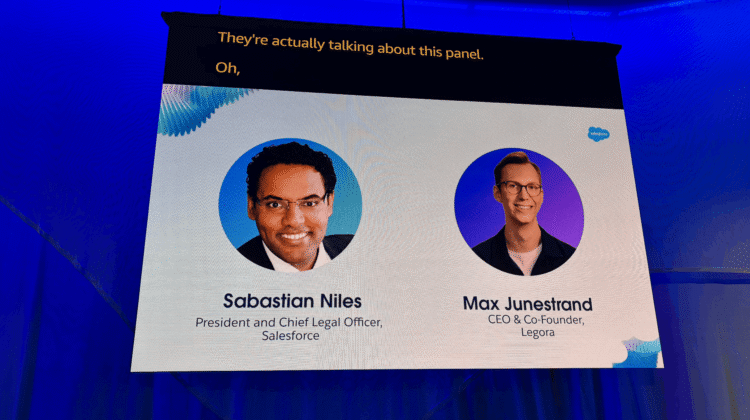
As artificial intelligence assumes increasingly complex legal tasks, lawyers will need to move upstream and design the systems, rules and guardrails governing that work, according to Legora CEO Max Junestrand.
Speaking with Salesforce President and Chief Legal Officer Sebastian Niles at Dreamforce in San Francisco, Junestrand argued that AI can exercise a form of judgment, but it cannot accept responsibility for the consequences.
“Even if we let an agent make judgment, a person has to be accountable,” Junestrand said. “A computer cannot be accountable, and I think that’s still true for agents.”
The conversation came as Salesforce selected Legora to support its global legal operations, reflecting the growing adoption of agentic AI by large corporate legal departments.
Founded in Stockholm in 2023, Legora has grown to more than 1,000 employees and is now used by roughly 150,000 lawyers, according to Junestrand. The company initially focused on law firms but is seeing increasing demand from chief legal officers and general counsel who want to bring more work in-house.
Junestrand said legal services remain constrained by the limited supply of qualified professionals, even as demand for contract review, regulatory analysis, litigation support and other legal work continues to grow.
“If you could review every contract, you would,” he said. “If you could have an agent think about your taxes all the time and make optimizations, or have an agent in an enterprise look at all the incoming regulation and how that affects the company, you would. But it’s too expensive.”
AI could expand the amount of legal work that gets completed rather than simply reducing the number of lawyers required. Junestrand expects agents to handle more initial analysis, research and document review while escalating decisions that require professional judgment.
He offered an early preview of Legora’s plans to bring its technology into Slack later this fall.
Legora is already testing the integration internally, allowing sales employees to ask an AI agent to review changes to contracts and non-disclosure agreements. The agent applies the company’s established negotiation playbook, accepts routine edits, identifies provisions outside approved parameters and prepares proposed markups before involving a lawyer when necessary.
“The UX and where that handoff happens, and the auditability of what the agents do, is really important,” Junestrand said.
Niles said Salesforce similarly uses Slack to help business teams access legal information and complete repeatable, high-volume work through self-service tools. That model preserves legal professionals’ capacity for matters involving greater risk, trust and strategic importance.
The challenge is particularly acute in law because legal work is harder to verify than software code. A developer can run code and quickly see whether it works, Junestrand explained, while a defective legal analysis may not reveal itself until much later, when the consequences can be significant.
That makes experienced lawyers especially valuable as supervisors of AI-generated work.
“Smarter, more experienced lawyers are substantially better drivers of the work because they are able to guide the agent,” he said. “More importantly, they are very good at reviewing the outputs of our system.”
Legora is attempting to balance generative AI with deterministic legal resources such as approved precedents and clause libraries. Junestrand cautioned against “vibe drafting” important provisions in major agreements when established language has already been tested in practice.
The aim is to give agents enough freedom to perform meaningful work without allowing them to wander beyond trusted information, policies and precedents.
“If it’s totally open, it just goes completely crazy all the time,” he said. “If you constrain it too much, it’s not very useful.”
Junestrand described AI implementation as a workforce transformation rather than a conventional technology rollout. Legal organizations must determine where agents can operate independently, where human review belongs in the process and which decisions must remain with lawyers.
As agents become more capable, he expects legal professionals to shift from reviewing every individual AI output to designing the systems under which those outputs are produced.
“You move upstream and you design the systems and the rule set and the guardrails under which AI will operate,” he said.
The transition could also reshape the relationship between in-house departments and external law firms. Corporate legal teams may conduct more preliminary dispute analysis, due diligence and contract review themselves, while continuing to retain outside counsel for bet-the-company litigation and other specialized matters.
Junestrand acknowledged that law firms face a difficult transition because greater productivity may conflict with the traditional hourly billing model. Some firms will adapt by moving toward outcome-based pricing and developing new services, while others may struggle with what he characterized as an innovator’s dilemma.
“You have to be very ambitious right now if you want to keep at it,” he said.
For lawyers, the central question is therefore not whether AI will participate in legal work, but how quickly professionals can reposition themselves around the decisions, strategy and accountability that machines cannot assume.
“We want to make every single lawyer in the world more productive and happier in the things that they want to achieve,” Junestrand said. “The complexity of the tasks that the system will be able to manage is continually going to increase, and professionals will have to continuously move up with that.”