





For companies building international teams, finding the right person can be easier than figuring out how to employ them. Each new market introduces unfamiliar employment laws, worker-classification rules, entity requirements and statutory deadlines. Large enterprises can turn to in-house legal departments and networks of local counsel. Smaller companies are often left coordinating law firms, consultants and spreadsheets—a fragmented system that becomes more expensive and difficult to manage with every border crossed.
Generative AI is already reshaping the legal profession. According to the 2026 Legal Industry Report, 69% of legal professionals now use generative AI for work, more than double the 31% reported a year earlier. Yet much of the legal AI market has focused on helping lawyers conduct research, draft documents and review contracts. It has done less to help companies turn legal information into action—forming and maintaining entities, classifying workers, monitoring deadlines and responding to regulatory changes.

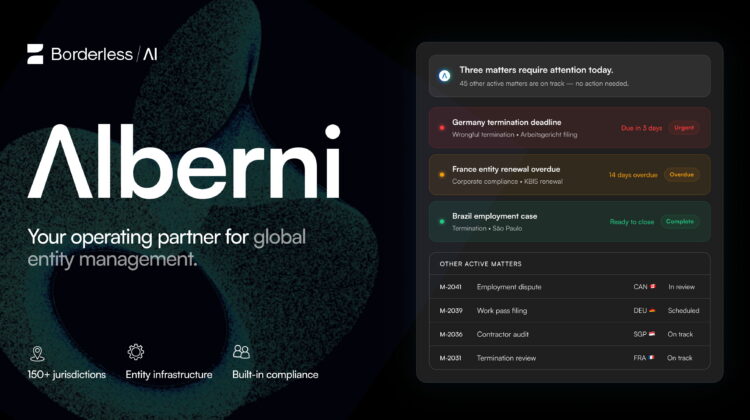
Borderless AI is targeting that gap with Alberni, an AI-powered legal operating system for global employment law and entity management. Launched as a unified platform spanning more than 150 international jurisdictions, Alberni combines specialized AI agents with legal expertise to help companies manage entity formation, workforce compliance, regulatory changes and employment disputes without assembling a separate legal infrastructure in every country.
Following the announcement, LegalTech.ca spoke with Borderless AI CEO and co-founder Willson Cross about why global compliance is an operational problem, where human legal judgment remains indispensable, and whether reducing the cost and complexity of international expansion could change where companies choose to hire.
What specific challenges were Borderless AI customers encountering with employment law and compliance that convinced you Alberni needed to become a dedicated legal operating system?
WC: Our customers were running into the same challenge of expanding into a new country and taking on a whole new set of employment laws, classification rules, deadlines, and local requirements. Having to learn a whole new set of employment and work laws remotely is a monumental task, and the complexity only increased as they entered more markets. We saw an opportunity to make legal compliance way easier from the start, instead of another layer of work for companies to manage.
Alberni is described as combining legal expertise with custom AI agents. Can you walk us through how a company would use the platform when entering a new country, from forming an entity to hiring its first employee?
WC: The idea is to give a company one place to manage the legal and operational requirements of entering a new market. Alberni helps companies set up and maintain entities, understand local employment and compliance requirements, and manage things like worker classification, documentation and key deadlines.
Most legal AI tools have focused on research, drafting, and litigation support. What makes global employment compliance an operational problem rather than simply a legal-information problem, and how does that distinction shape Alberni?
WC: It’s one thing to know what the law says, but companies also need to put that information into practice, making sure workers are classified correctly, deadlines are met, entities stay up to date, and policies reflect the latest requirements. For example, if a country’s employment law changes, Alberni can notify the right team, flag what needs to be updated, and help prepare and file the required documentation. Global employment law affects the day-to-day running of a business, which is why Alberni is designed as an operating system rather than simply a legal research tool.
Employment laws and regulatory requirements can change quickly and vary significantly between jurisdictions. How does Borderless AI keep Alberni’s guidance current and accurate across more than 150 locations, and where does human legal oversight remain essential?
WC: AI is only as useful as the expertise behind it. Alberni pairs AI with Borderless AI’s existing global employment infrastructure and legal expertise, so regulatory and compliance information is tracked continuously and built directly into the workflows companies already run on. But AI doesn’t replace legal judgment, and it’s not meant to. Complex matters, disputes, and anything requiring interpretation or accountability still need a human lawyer’s judgment. That’s the human in the loop, and it isn’t going anywhere. Alberni handles the pattern-rich work instead, flagging risk alerts and automating compliance tasks, so lawyers and consultants stay focused on the calls only they can make. It’s the backstop companies lean on to navigate disparate legal systems across global borders.
Alberni can support worker classification, document generation, regulatory monitoring, and workforce disputes. How do you determine which decisions AI can safely automate and which should remain in the hands of lawyers or HR professionals?
WC: AI takes the pattern-rich, routine work; people step in when a situation calls for judgment or a deeper read on the details. Monitoring deadlines and generating standard documentation, that’s work that can be highly automated. A complex worker classification question or a workforce dispute is different. The goal isn’t to automate everything, but to make sure the right work gets done by the right combination of technology and people.
The platform becomes more tailored as it accumulates context about a company’s entities, cases, and jurisdictions. What safeguards are in place to protect sensitive employee and legal information, prevent bias, and ensure companies understand how recommendations are produced?
WC: Trust is the foundation of legal work. But as companies entrust AI with increasingly sensitive employee and business information, trust cannot be assumed. It has to be built into the system. Alberni protects sensitive data and grounds every recommendation in the relevant legal, jurisdictional, and business context. And when the stakes are highest, technology alone is not enough. Alberni brings human experts into the process, combining the speed of AI with the judgment and accountability complex legal decisions require.
Supporters of legal AI point to lower costs and faster service, while critics raise concerns about accuracy, accountability, privacy, and the future of legal work. Which concerns do you consider most legitimate, and how should the legal and HR industries respond?
WC: Accuracy, accountability, and privacy are the ones I take most seriously. Legal AI can’t be treated like a general-purpose chatbot when the stakes are this high, and any company that treats it that way deserves the scrutiny it gets.
The future of legal work is a fair question, but I’d push back on the framing. The work shifts; it doesn’t disappear. AI takes on the repetitive part, the drafting, the tracking, the document review. That’s what frees up lawyers and HR teams for the calls that actually need their judgment.
So the industry’s response isn’t to slow down; it’s to build responsibly. Keep legal expertise and human oversight built into the product itself, not added on as an afterthought. Lower costs and faster service only matter if what comes out the other side still holds up.
Looking ahead five years, how do you expect AI to change global hiring, compliance, and workforce management—and could reduce the cost and complexity of entering new markets materially change where companies choose to hire?
WC: I think we’re going to see global hiring become a lot more accessible. Today, companies choose where to hire based on talent, but just as much on how hard it is to actually operate there. Take away the legal and operational hurdles, and companies hire based on where the talent is, not where it’s easiest. Over the next five years, compliance becomes a behind-the-scenes part of running a global team. That only works if what’s underneath is built right. Our approach is hybrid: real legal expertise combined with LLMs, not either one alone. Legal keeps it accurate, and the LLM makes it fast enough to operate at global scale.