





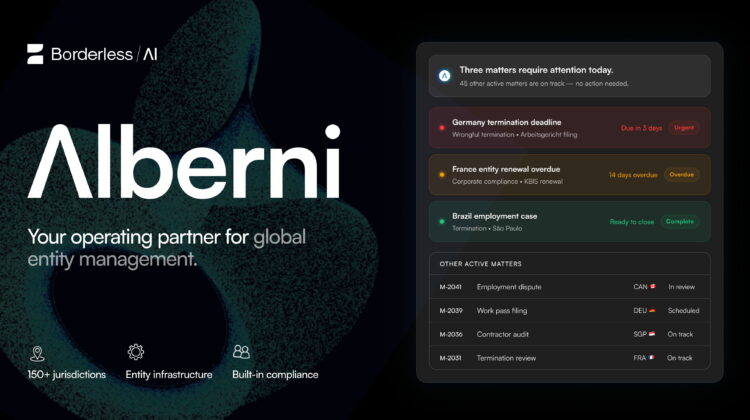
Toronto-based Borderless AI has launched Alberni, an AI-powered legal operating system designed to help companies manage employment law, corporate entities, and workforce compliance across more than 150 international jurisdictions.
The new platform brings together legal expertise and specialized AI agents in an effort to replace the mix of local law firms, consultants, spreadsheets, and internal processes that companies often rely on when expanding into new markets.
Borderless AI says Alberni can support a company throughout its international operations, from forming and maintaining local entities to classifying workers, monitoring regulatory changes, tracking statutory deadlines, and managing workforce disputes.
The launch expands the Toronto company’s focus beyond its core employer-of-record and global payroll services. Borderless AI already helps businesses onboard, pay, and manage workers in more than 170 countries without requiring them to establish a foreign entity in each market.
Alberni is intended for companies that want to operate through their own entities as well as those using other international employment models. The platform creates a centralized record for each entity, legal matter, and jurisdiction, allowing its recommendations and workflows to draw on an organization’s accumulated history.
According to Borderless AI, Alberni offers four main groups of capabilities.
Its entity infrastructure supports formation, ongoing maintenance, and compliance monitoring. Its compliance tools cover worker classification, regulatory updates, statutory deadlines, and employment disputes. AI-powered legal features include case intake and analysis, procedural scheduling, document generation, and a dashboard for tracking caseloads. The company also says the system can use historical outcomes and organizational context to make its assistance more tailored over time.
“We built Alberni so legal and regulatory compliance works like infrastructure: always on, always current, and smarter with every case,” said Willson Cross, chief executive officer and co-founder of Borderless AI.
The product arrives as generative AI adoption moves deeper into legal workflows. Much of the legal AI market has concentrated on tools for lawyers, including research, drafting, contract review, and litigation support. Alberni takes a different route by embedding legal capabilities directly into the operational systems used by companies employing workers internationally.
That positioning also reflects a broader shift in legal technology. AI providers are increasingly moving from standalone assistants toward integrated platforms that can initiate workflows, track obligations, produce documents, and retain context across matters. For in-house teams, the appeal is not simply faster answers but a more consistent way to manage recurring legal work.
Global employment is a demanding test for that model. Requirements can differ substantially between jurisdictions, and compliance depends on current local law as well as the facts of each employment relationship. Borderless AI is betting that a combination of legal expertise, AI agents, and operational infrastructure can help companies manage that complexity without adding legal headcount at the same rate as their international footprint.
The company has not disclosed pricing for Alberni or detailed how its AI-generated analysis is reviewed by legal professionals. Its claims about the platform’s speed, consistency, and jurisdictional coverage are company-reported.
For Borderless AI, the launch represents an effort to turn global compliance from a collection of external services into an always-on technology layer. If the model proves reliable at scale, Alberni could also illustrate how legal AI is expanding beyond the systems used by law firms and into the infrastructure companies use to conduct business across borders.