





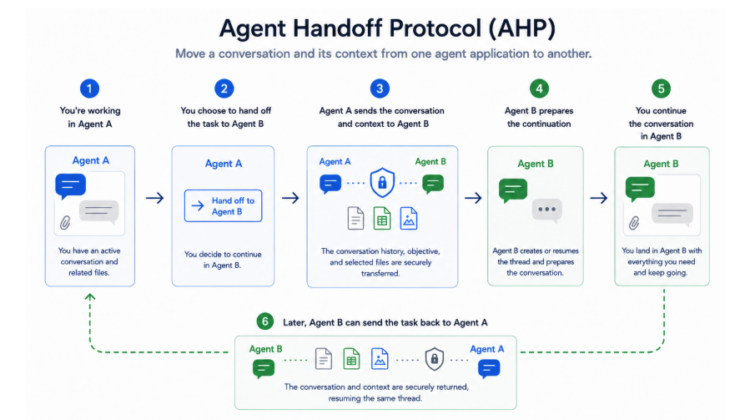
An open specification aims to let lawyers carry active work between specialized AI platforms without rebuilding prompts or uploading the same files again.
DeepJudge has introduced an open protocol designed to help legal professionals move a task from one artificial intelligence platform to another while preserving the context needed to continue the work.
The Zurich-based company calls it the Agent Handoff Protocol, or AHP. Harvey is implementing the protocol in an integration entering beta this month, while Toronto-headquartered Thomson Reuters is supporting the initiative. Details and timing for the Thomson Reuters implementation have not been announced.
AHP addresses a growing problem as lawyers use different systems for internal knowledge, legal research, drafting and analysis. Moving between them typically means copying prompts, reattaching files and explaining the assignment again. The protocol is intended to send the next platform a user-approved package containing the task objective, selected conversation context, relevant resources and continuity identifiers.
DeepJudge gives the example of a lawyer researching a precedent question in its platform before moving into Harvey. The Harvey session could open with the relevant context already in place, allowing work to continue without recreating the prompt or uploading the same materials.
“No single AI experience will be the right one for every task,” DeepJudge co-founder and chief technology officer Yannic Kilcher said in the announcement.
AHP differs from the Model Context Protocol, or MCP. MCP gives an AI application access to outside tools and data while the user generally remains in the same product. AHP moves the user and task into a prepared session in another application. It does not transfer credentials, hidden reasoning, system prompts or access to a vendor’s private tools.
Harvey and DeepJudge already have a product partnership intended to bring law firms’ internal knowledge into Harvey workflows. DeepJudge also integrates with Thomson Reuters CoCounsel Legal, allowing joint subscribers to find firm materials and use selected documents in drafting, analysis and research.
For law firms and legal departments, a common handoff layer could reduce repetitive setup and make specialized tools easier to combine. It may also give buyers more flexibility to assemble a technology stack instead of relying on one vendor for every stage of a matter.
Portability also creates a governance boundary. A handoff may include conversation history, filenames, work product and client materials. Canadian firms evaluating AHP-based integrations will need to examine privilege, confidentiality, client consent, data location, cross-border processing and whether document permissions and ethical walls remain effective as information moves between vendors.
AHP is currently a draft version-one specification, although DeepJudge says its technical contract is stable enough for partner integrations. The company has released the documentation under the Apache 2.0 licence and is inviting other AI providers and law firms with in-house systems to participate.
Harvey’s beta will provide an early test of whether the protocol can make cross-platform legal work feel continuous. Thomson Reuters’ eventual implementation could show whether that portability can extend across established research, knowledge and drafting systems without weakening the controls legal work requires.