





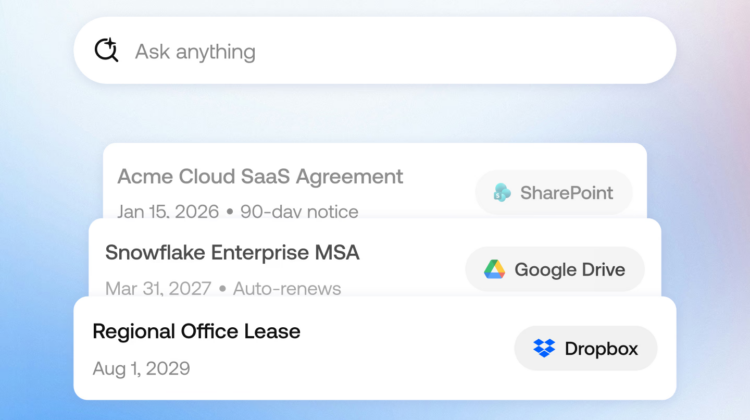
The contracts a company has already signed may be its most valuable—and least accessible—legal dataset. GC AI wants to make that archive searchable.
The San Francisco-based legal AI company has launched Contract Intelligence, a new capability designed to let in-house teams ask questions across large collections of contracts and receive answers linked to the underlying language.
The product targets a persistent weakness in contract lifecycle management: while many CLM platforms support drafting, negotiation, approval, and signing, extracting reliable information after execution can still require manual tagging or document-by-document review.
Contract Intelligence is intended to turn those stored agreements into a queryable source of business and legal information. Users can ask questions in plain language—such as which vendor agreements will auto-renew within 90 days—and receive the results in a live, filterable table. Selecting a result takes the user to the passage from which the information was drawn.
GC AI says the system can analyze up to 100,000 contracts in a single vault. It classifies documents by status, distinguishing fully executed and partially signed agreements from unsigned documents and drafts. It can also rename files according to a customer’s preferred convention and connect amendments, renewals, statements of work, and related agreements so users can follow the history of a transaction and determine which terms govern today.
That document-family capability may be as important as the question-and-answer interface. A single commercial relationship can span a master agreement, several amendments, multiple statements of work, and years of renewals. Reviewing one document in isolation can produce an incomplete picture even when the extracted text is accurate.
The company says Contract Intelligence can work with documents stored in Google Drive, Dropbox, Ironclad, SharePoint, and OneDrive, avoiding an initial migration into a new repository. A DocuSign connection is planned.
GC AI positioned the launch as part of a broader expansion that also includes an API, in-chat redlining, built-in legal AI classes, and connectors to more than 20 business applications. The company says its platform is used by more than 2,000 organizations.
The announcement comes as legal AI providers move beyond drafting and research toward systems that can reason across an organization’s own records. For in-house teams, that shift could make contract repositories useful for questions involving renewals, notice deadlines, pricing, indemnities, and other negotiated obligations. It could also give legal departments a faster way to support procurement, finance, compliance, and corporate development.
The value will depend on more than retrieval speed. Legal teams will still need to test how the system handles poor-quality scans, inconsistent naming, missing documents, conflicting amendments, and unusual drafting. Citations make an answer easier to verify, but they do not remove the need for legal judgment or controls around high-consequence decisions.
“This isn’t about replacing legal judgment,” GC AI co-founder and CEO Cecilia Ziniti said. “It’s about making sure that judgment is never operating on half the picture.”
GC AI says uploaded documents are encrypted and isolated by tenant and are not used to train models for other customers. The platform offers role-based permissions, along with SSO, SAML, and SCIM for enterprise deployments. The company also says its architecture is designed to support SOC 2 Type II, SOC 3, GDPR, and CCPA compliance.
For Canadian legal departments, the product’s ability to connect with existing repositories may lower the operational barrier to testing it. Buyers will nevertheless need to examine data location, cross-border processing, privilege and confidentiality protections, retention and deletion terms, and alignment with Canadian privacy obligations. The launch announcement does not identify a Canadian data-residency option or a Canada-specific rollout.
Contract Intelligence is launching by invitation. GC AI will demonstrate the product during a webinar on August 19, 2026, with prospective customers able to join a waitlist for early access.