




Harvey is inviting Canadian legal teams to sign up for early access to a new fact graph capability designed to turn large volumes of litigation and investigation documents into a shared, connected factual record.
Unveiled at Harvey Forum Chicago, the preview accompanies the general availability of Harvey Agents in Outlook, bringing the company’s custom legal AI agents directly into lawyers’ email and scheduling workflows.
The announcements expand Harvey’s support for both substantive legal work and the administrative tasks surrounding it, with applications for law firms and in-house departments.
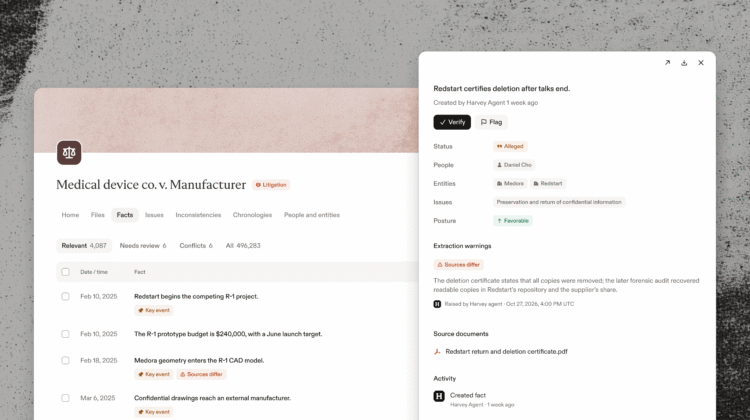
For litigators and investigators, the fact graph addresses a recurring challenge: keeping facts, evidence, and analysis connected as a matter develops.
Harvey says the capability can extract relevant facts from millions of documents, link them to supporting source pages, and organize them around people, entities, events, and legal issues. It also surfaces potential inconsistencies for lawyers to review.
As new evidence arrives, the factual record and chronologies update. Teams can then use pre-built or custom Harvey agents to generate timelines, proof charts, deposition outlines, and briefs from that record.
A shared matter workspace brings together source documents, extracted facts, chronologies, and work product, allowing in-house counsel, outside firms, and colleagues joining a matter to work from the same information. An activity log records progress, while task management helps coordinate work through the matter’s phases.
Harvey says approximately one-third of its users are litigators. The company is developing the new capabilities with design partners including British law firm Slaughter and May.
“Our disputes and investigations lawyers are trusted by our clients globally with their most complex matters, where deep expertise and judgement are critical,” said Richard Jeens, disputes partner and a member of Slaughter and May’s Innovation Committee.
“Working with Harvey as a design partner gives us the opportunity to combine the breadth and depth of our experience with their technology expertise to shape tools to deliver effectively what our clients need.”
The litigation and investigations capability remains an Early Access preview, with Canadian teams now able to register their interest.
Lawyers can build an agent in Harvey’s Agent Builder and use it within Outlook, following their team’s instructions and drawing on connected knowledge sources and precedent. Agents can run on recurring schedules and, with the Outlook connector enabled, work across multiple emails.
The offering can provide daily summaries, highlight messages requiring attention, flag outstanding follow-ups, and recommend calendar changes. It can also search inboxes, draft emails, create tasks, categorize correspondence, and file emails and attachments to Harvey’s Vault.
Harvey says lawyers retain control over those actions: no email is sent, calendar event added, or email saved to Vault without explicit user approval.
For in-house departments, the launches sit within a broader suite that connects incoming business requests with legal work and ongoing oversight.
Harvey’s Intake gathers information and routes requests to the appropriate lawyer, agent, or solution. Contract Intelligence supports contract review through signature and subsequent tracking of obligations, renewals, and risk. Other capabilities address regulatory monitoring and outside counsel spending.
Harvey continues to build momentum with in-house legal teams in Canada, with customers including TC Energy, AtkinsRéalis, Dentalcorp, and RONA. These teams are part of a global customer base that includes five of the Fortune 10—among them CVS Health—as well as Lockheed Martin, GE Aerospace, and Microsoft.
Together, the announcements reflect Harvey’s effort to preserve context across legal workflows—from an initial email or business request to the evidence, analysis, and work product needed to resolve a matter.