





Vancouver-founded legaltech Clio is giving law firms greater control over how its Vincent AI platform performs legal work.
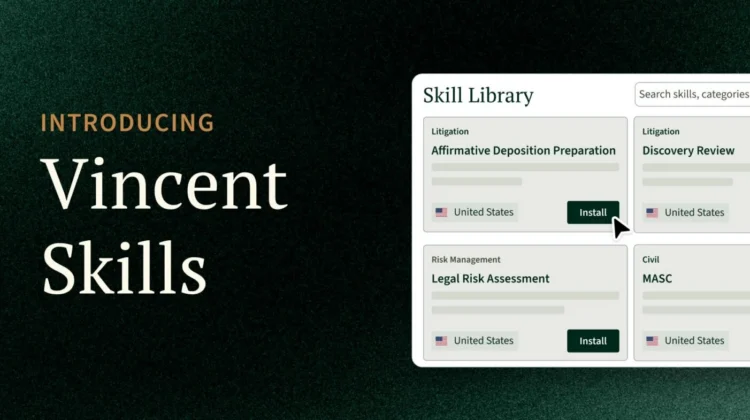
The company has launched Vincent Skills, a new capability that allows firms and corporate legal departments to translate their internal methods, preferences, and standards into instructions the platform can apply repeatedly.
Users can create a Skill in plain language to define how Vincent should approach a particular task. Once approved and published, the Skill is automatically applied whenever the relevant context arises, eliminating the need for lawyers to enter the same prompts during every session.
A firm could create Skills governing how research is conducted in a particular jurisdiction, how specific contracts are drafted, or which conventions should be followed when reviewing documents.
“Reusable prompts are quickly becoming table stakes,” said Dan Hoadley, Senior Director of Product Management at Clio.
Hoadley said the more difficult challenge is turning a firm’s standards into governed AI capabilities that lawyers can use consistently. Vincent Skills is designed to capture that institutional expertise and make it available across attorneys and matters.
The platform includes predefined Skills for research, drafting, summarization, matter analysis, and document review. Authorized lawyers and administrators can also modify existing Skills, build their own, or convert a successful interaction with Vincent into a reusable Skill.
Clio has introduced a tiered permissions system to govern how those capabilities are deployed. Administrators determine which lawyers can access individual Skills, while designated builders can create and refine them. Skills can also be tested and previewed before receiving the administrative approval required for wider use.
Alongside Skills, Clio is launching a personal preference layer that allows individual lawyers to set their preferred tone, format, and other output conventions once. Vincent will then carry those preferences into future work.
The company also announced Memory, a separate Vincent capability that carries information forward from earlier interactions. It can surface details about how previous tasks were completed, the parties involved, and earlier drafting decisions—even when those details were not formally added to a Skill.
Memory can also identify potential inconsistencies between new matter activity and previously recorded information, such as conflicting dates appearing in a document and a communication. Clio says Vincent does not train on matter data and applies Memory within established data-retention periods.
Together, Skills and Memory represent an effort to move legal AI beyond one-off prompting. Skills preserve how a legal team wants work performed, while Memory provides continuity as a matter develops—giving firms a way to scale internal expertise while maintaining human review and administrative control.