





LawDroid is adding research talent at a time when legal aid organizations are being asked to serve more people with fewer resources.
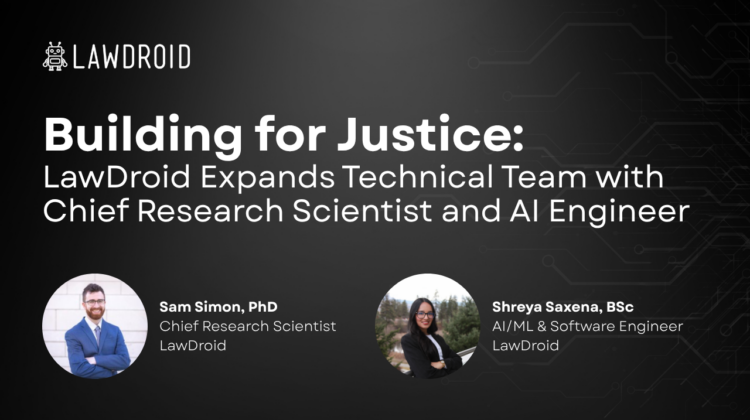
The Vancouver legal AI company announced that Sam Simon, PhD, has joined as Chief Research Scientist, while Shreya Saxena, BSc, has joined as AI/ML & Software Engineer. The appointments strengthen LawDroid’s technical team as the company continues building AI tools for legal aid organizations, court self-help programs, and public-interest legal providers.
The pressure on those organizations is significant. According to the Legal Services Corporation’s Justice Gap Report, low-income Americans received little or no legal help for 92% of their civil legal problems. The World Justice Project’s 2025 Rule of Law Index also ranks the United States 112th out of 143 countries for accessibility and affordability of civil justice, a drop of more than 40 places since 2015.
For LawDroid CEO and Founder Tom Martin, the hires are directly tied to the company’s access-to-justice focus.
“Access to justice is the whole reason the legal system is supposed to exist, and too often we treat it as an afterthought,” said Martin. “For ten years we have built for the people that system tends to overlook. Hiring Sam and Shreya is how we make good on that promise at a scale that finally matches the size of the need.”
Simon brings more than a decade of experience at the intersection of machine learning research and real-world application. As Chief Research Scientist, he will lead research and development into advanced mathematical frameworks designed to improve the reliability and logical consistency of generative AI systems.
For legal aid groups and court self-help programs, the margin for error is narrow. LawDroid says Simon’s work will focus on helping make generative AI systems more dependable in settings where users may be navigating serious legal problems without a lawyer.
Before joining LawDroid, Simon led R&D projects in time-series data analysis and natural language processing across areas including complex network dynamics, orbital mechanics, and financial signal extraction. He holds a PhD and MS in Mathematics from Simon Fraser University and a bachelor’s degree in Mathematics and Physics from Carnegie Mellon University. He has published eight peer-reviewed journal articles and presented at international conferences across North America and Europe.
“I’ve spent my career working on hard research problems,” said Simon. “Access to justice turns out to be one of the hardest. I’m here because the work at LawDroid contributes to a more equitable society.”
Saxena joins LawDroid as an AI/ML & Software Engineer, where she will support the development of scalable software systems for technology-driven legal services and operational automation. She holds a Bachelor of Science with Honours in Computer Science from the University of British Columbia.
“LawDroid is doing work that means something, for people who don’t always have someone in their corner,” said Saxena. “The problems are real, and the stakes are high, and that matters to me.”
The new hires follow a period of active research and open-source work for LawDroid.
Earlier this month, Martin published “A2JRAG: Process-Aware Retrieval-Augmented Generation for Public Legal Information Systems,” a research paper co-authored with Scheree Gilchrist, Chief Innovation Officer at Legal Aid of North Carolina. The paper explores how AI systems can provide not only accurate legal information, but information that fits a person’s specific stage in the legal process.
LawDroid also recently released the Legal Aid Plugin, a free, open-source tool for Anthropic’s Claude platform, built for civil legal aid organizations, court self-help programs, and public-interest legal providers.
LawDroid’s AI research and development is supported in part by the National Research Council of Canada Industrial Research Assistance Program, which supports Canadian small and medium-sized businesses undertaking scientific research, product development, testing, and validation of AI technologies.
LawDroid says additional technology launches are planned for the second half of 2026.