





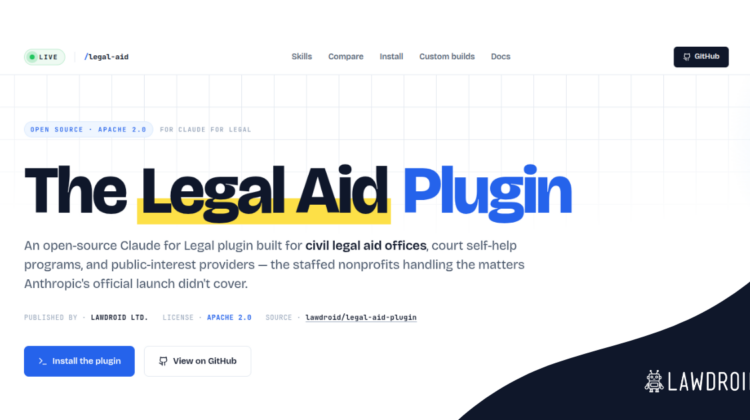
LawDroid has launched a free, open-source Claude plugin designed specifically for civil legal aid organizations, court self-help programs, and public-interest legal providers.
The Legal Aid Plugin is built to bring access-to-justice organizations into the fast-growing legal AI ecosystem at a time when much of the sector’s attention has been focused on commercial law firms, corporate legal departments, and BigLaw use cases.
Available through LegalAidPlugin.org and GitHub, the plugin is designed for organizations using Anthropic’s Claude AI platform. LawDroid says it is intended to help legal aid teams reduce administrative burden, improve workflow consistency, and serve more people with limited resources.
“Civil legal aid is not BigLaw on a smaller budget,” said Tom Martin, Founder and CEO of LawDroid. “It is a fundamentally different practice environment with different clients, funding rules, staffing realities, ethical considerations, and operational demands. Legal aid organizations do not need generic AI tools retrofitted to their work. They need infrastructure designed around how legal aid actually operates.”
The launch follows Anthropic’s recent expansion of Claude for Legal, which introduced new legal workflows, integrations, and practice-area tools. While that announcement marked another major step in legal AI adoption, LawDroid says legal aid organizations, court self-help centres, and public-interest providers were largely left out of the conversation.
The Legal Aid Plugin supports operational workflows including client intake, eligibility screening, document drafting, attorney supervision, case handoffs, funder reporting, client communications, case summaries, deadline tracking, and routine correspondence.
The plugin is also designed to work alongside legal and productivity tools including CourtListener by Free Law Project, Descrybe, Courtroom5, Slack, Google Drive, and local file access.
LawDroid says the project is fully open-source, requires no separate accounts, does not depend on a SaaS platform, and allows organizations to maintain control over their own systems and data. While Claude itself requires a subscription, Anthropic offers nonprofit discounts to eligible organizations.
Sally Chaffin, Practice Innovation Manager at Atlanta Legal Aid Society, said the open nature of the project is central to its value.
“What matters about this launch is not just the plugin,” Chaffin said. “It’s published openly, free to use, and open to contribution from any legal aid organization, anywhere. The civil legal aid community needs technology built that way.”
The announcement comes amid persistent concerns over the justice gap. According to the Legal Services Corporation’s Justice Gap Report, 92 percent of low-income Americans receive no legal help or insufficient legal help for their civil legal problems.
LawDroid says the plugin is not intended to replace lawyers or legal staff, but to support overstretched teams facing rising demand, staffing pressures, and funding uncertainty.
“The legal aid community has spent years being asked to do more with less,” Martin said. “We’re publishing this plugin openly so any office can deploy it for free. This launch is an invitation to the entire legal aid community: deploy it, tell us what works, and help us build what comes next.”
LawDroid is hosting a webinar and walkthrough on June 1, 2026, at 10am PT, covering installation, setup, workflow examples, and real-world use cases for legal aid organizations.