





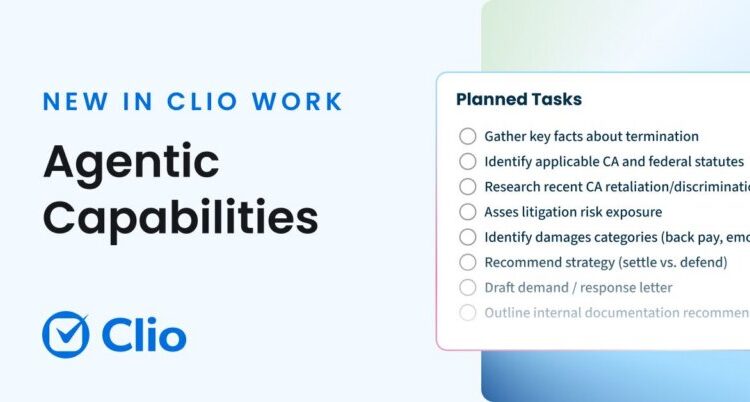
Clio is advancing its legal AI platform with the introduction of agentic capabilities in Clio Work, enabling lawyers to complete complex, multi-step tasks from a single prompt.
The update allows legal professionals to delegate work using natural language instructions—such as building a defence strategy or identifying deal risks—while the system executes the required steps autonomously. The shift reflects how lawyers already interact with AI, with Clio noting that 84% of queries are now freeform and goal-based.
“Clio Work’s agentic capabilities allow legal practitioners to delegate complex, multi-step tasks to a truly collaborative AI assistant, without sacrificing control or visibility,” said John Foreman, Chief Product Officer at Clio.
Unlike traditional workflows that require users to guide each step, Clio Work determines the sequence of actions needed to complete a task, drawing on a range of contextual data. The platform also surfaces real-time “thinking traces,” allowing users to monitor progress, intervene, or redirect tasks midstream.
The functionality is powered by what Clio describes as a “skills infrastructure”—a set of legal-aware capabilities that the system can invoke automatically depending on the task. Rather than requiring manual input, Clio Work identifies the appropriate tools and executes them in a continuous workflow.
The update is designed with solo, small, and mid-sized firms in mind, aiming to reduce time spent on non-billable work while expanding capacity. By offloading administrative and analytical tasks to AI, firms can focus more on client interaction, strategy, and higher-value legal work.
Agentic capabilities are now available by default to all Clio Work users, with no additional setup required.
The release marks Clio’s latest move to embed AI more deeply into legal workflows—shifting from assistive tools toward systems that can independently carry out substantive legal tasks.